Latest News
About GMC
Ocean Freight
Air Freight
Shipping Toolkit
Contact Us
Request a Quote
2022.09.02
|CEP
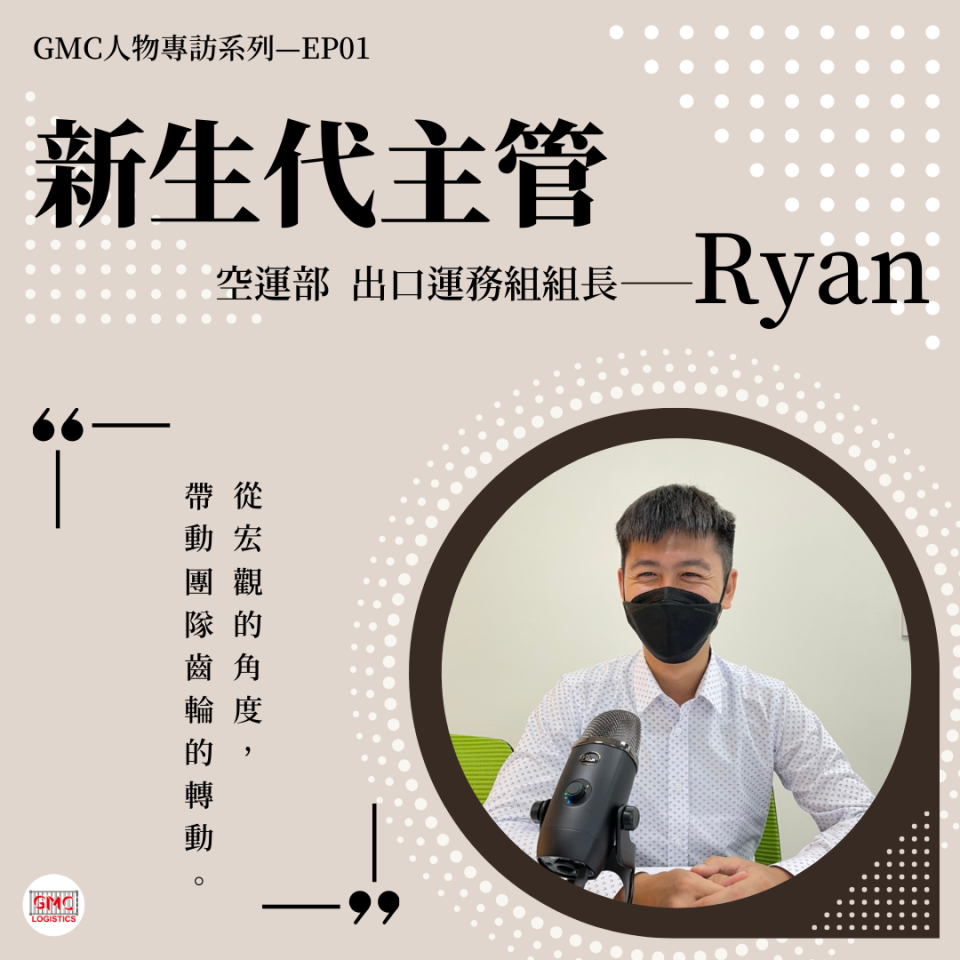
With a confident stride and a consistently warm demeanor, Ryan radiates approachable energy even behind a mask. He is our interviewee today—Ryan, the current Air Freight Export Operations Supervisor.
◤ In July 2017, he made the bold decision to plunge into a completely unfamiliar industry… ◢
Recalling his first day on the job, a slight smile broke across Ryan's face. "What stands out most was that Joy (Ziqiang) and I started on the exact same day. I didn't think too much of it at the time, but it was neat to have a peer start with me. Together, we’ve fought our way through to where we are now."
◤ Having never stepped foot in this sector before, every single step was a hurdle. ◢
At the time, the Air Freight Division was undergoing a reorganization, leaving manpower exceptionally tight. For a newcomer, high adaptability and a steep learning curve were absolute prerequisites. Tasks ranging from quoting, pricing, and data entry to communicating with airlines and co-loaders had to be mastered in a very short window. Navigating the freight forwarding business with only a vague concept of its inner workings, Ryan began his very first lesson as a rookie: memorizing world maps and airport codes.
In the blink of an eye, five years have passed. The industry novice of yesteryear has now become one of the company's key nurtured talents.
"Even though the core role revolves around co-loading, we also engage in business development just like sales representatives," Ryan noted. "The difference is that we develop relationships with fellow forwarders (co-loaders) rather than direct clients."
The primary responsibility of a co-load specialist is to consolidate freight rates, lane specialties, and consolidation services across various co-loaders, bearing the responsibility to secure larger profit margins for the company and its sales team. Beyond the company's own space commitments, whether a sales rep can successfully move cargo and secure a competitive rate often hinges on how well the co-load specialist maintains relationships within the industry.
When he first started knocking on the doors of industry peers, he faced hurdle after hurdle. The very first challenge he frequently encountered was getting a cold shoulder.
◤ "First of all, being rejected is completely normal!" ◢
Ryan spoke with a serious tone, his eyes flashing with determination. He appeared entirely unfazed by setbacks; if anything, he seemed to relish the challenge. Aside from handling rejection, another major hurdle for rookies is not understanding the industry jargon being thrown around.
Even when his mind was completely frantic, he had to maintain a calm, collected voice on the line. While frantically scribbling down unfamiliar technical terms and shipment details on his side of the phone, he still had to project a thoroughly professional and reliable front to the partner. The moment the call ended, he would immediately rush to ask his colleagues about the parts he didn't understand. Reminiscing about that initial anxiety, Ryan smiled, looking back at his younger self with a sense of humor.
◤ "Air freight definitely has its Standard Operating Procedures (SOPs), but the fascinating part is that variables can pop up at any stage." ◢
When asked about unexpected incidents in air freight, Ryan answered without a second thought. Sometimes it’s a client throwing a curveball out of nowhere; sometimes it’s an abrupt logistical emergency; and other times it’s dealing with an entirely novel type of cargo. One hundred orders come with one hundred different approaches. Every single day brings new puzzles waiting to be solved. As his experience grew, so did his composure. "Unexpected situations can actually be quite entertaining. Though you're completely dumbfounded in the moment, looking back now, they're just hilarious," Ryan said.
◤ Building experience through real-world battles, then internalizing that experience into true expertise. ◢
Handling specialized cargo is a common occurrence in air freight. He recalled a time right after the Taitung Hot Air Balloon Festival ended, when the hot air balloons had to be shipped back to Europe. "The fabric and the baskets of the hot air balloons are treated as general cargo. The tricky part was the gas cylinders. Because gas cylinders are classified as dangerous goods (DG), they require a certified empty/purge certificate before they can be cleared for shipping," Ryan shared.
"We also frequently handle oversized and over-length cargo. I have a client who regularly ships special mechanical pipes for machinery parts. The shorter ones are around 200 centimeters, but once we shipped one that was over 500 centimeters long. At the time, I thought to myself, Wow, how on earth are we going to move this? Man, that was incredibly long!" When discussing special cargo, Ryan could hardly hide his excitement.
He also shared his experience shipping high-value cargo: "Paintings are classified as valuable cargo because the value of art is immeasurable. A single painting can easily range from several hundred thousand to millions of dollars. Furthermore, artwork cannot be stacked, pressed, or bumped. Therefore, the handling during transit requires an extraordinary level of precision and care."
After five years of sharpening his skills, Ryan is now a veteran who stays cool under pressure. "The daily workload varies immensely. Although it was terrifying at first, practice makes perfect. Even if a situation arises that I’ve never encountered before, I can react instantly and guide the client on how to handle it." Innumerable situations can happen during transit, and things can go sideways at any link. While it causes a massive headache in the moment, looking back, Ryan only smiles. After all, without those initial trials, the professional expertise he holds today wouldn’t exist.
In terms of service, air freight is broadly divided into Air Export, Air Import, and Air Triangle Trade. In terms of functional roles, it is split into Documentation & Customs Clearance, Customer Service (CS), and Co-Load. In addition to his core co-load responsibilities, Ryan spent half a year working hands-on in documentation and customs clearance. It was during this stint that he gained his first holistic understanding of the air freight pipeline.
"Because I fully understood the documentation and customs clearance side, later when I faced industry peers, I could confidently tell them how to amend a Master Air Waybill (MAWB) or how operations actually run. I had that backbone because I knew what I was saying was factually correct," Ryan stated with absolute certainty and confidence.
Armed with a comprehensive understanding of each role, he can better allocate manpower within his team, ensuring everyone is in the right position to maximize their value. This naturally makes one curious: what are the natures of these three roles—Documentation, CS, and Co-Load—and what traits do they value most?
✈ Documentation & Customs Clearance: Patience, Attention to Detail, Stability
When performing physical operations, cross-checking, and keying in data, one must invest time and handle details meticulously. Since it involves a fixed time cost that is hard to shortcut, and the daily workload has a higher level of repetition, it is well-suited for individuals with a steady and stable personality.
✈ Customer Service (CS): Attention to Detail, Proactivity, Tactfulness
CS also demands patience and attention to detail, but with an added layer of direct client interaction. It requires smooth negotiation skills and polished interpersonal handling. Therefore, it is ideal for individuals who are proactive yet exceptionally attentive to details.
✈ Co-Load: Proactivity, Flexibility, Agility
This role encapsulates all the traits of a CS professional, but adds the requirement of building deep rapport with industry peers. When arranging cargo exports, one must know exactly which airlines fly to the destination and who to turn to for securing space or splitting bills. Finding solutions for clients requires an incredibly high level of agility and sharp problem-solving skills under pressure.
"An individual contributor generally just needs to perfectly resolve the tasks within their own remit. Once the assigned items on your plate are handled, your workday is done. It’s like interconnected links in a iron chain—as long as I finish my part and don't negatively impact the next person down the line, I'm basically meeting expectations," Ryan explained.
"But when you step up to a managerial position and take on leadership responsibilities, you can no longer view it that way. Beyond getting your own tasks done, you have to look ahead and behind, understanding the overall operational flow, the cause-and-effect logic, and how to optimize current practices. You have to zoom out out to see where the actual bottlenecks lie."
In contrast to the "chain link" mentality of a standard employee, Ryan compares his team to a set of gears—and he views himself as the lubricant for those gears. Ensuring that every team member spins smoothly allows the entire team to operate much more efficiently! Ryan also holds clear philosophies when it comes to talent selection: "Every colleague has a distinct personality and different areas of expertise. On top of that, air freight teams are lean yet highly specialized, making it all the more critical to put the right people in the right positions so their value can truly shine!"
During his years at GMC, moving from a complete rookie who asked questions whenever he didn't understand something to now leading the Air Freight Export Operations Team as a seasoned veteran, who has influenced Ryan the most or earned his deepest gratitude?
"The person I want to thank the most is definitely Joy," Ryan said. "When I first joined, he was already an incredibly experienced senior colleague. Along the way, he was like my master. He started by teaching me basic professional knowledge so I could handle foundational operations independently, and later he gradually let me take on more. Whenever I ran into weird situations or bizarre cases, he was like my Doraemon—I could go to him with any question and seek his guidance. I feel incredibly lucky on that front!"
This Policy was last updated on July 6, 2026.